Key takeaways
- Tabular Editor Forge is a research arm of Tabular Editor ApS: The purpose is to research and share our findings and experiments regarding the evolution and changes in the area of BI and data analytics due to AI and agents.
- TE Forge shares experiments that we deem useful as free software: Many internal experiments we’ve completed in the last year are complete and useful, but we had no mandate to share them. This software is shared under a specific end user license agreement.
- Experiments vary in their size, scope, and focus: Some might be simple scripts for Tabular Editor or other tools, while others could be extensions, plugins, or complete tools, engines, or frameworks. Our first officially published experiment is Tabular Editor Lite, a lightweight tool that brings the capabilities of TE2 and TE3 to VS Code for semantic model development when you work with coding agents.
This summary is produced by the author, and not by AI.
Forging new hammers in Tabular Editor
Today we’re launching Tabular Editor Forge, the research arm of Tabular Editor, and releasing its first experiment: Tabular Editor Lite, a lightweight extension that brings the capabilities of TE2 and TE3 to VS Code for semantic model development with coding agents. Tabular Editor Lite is free, and you can download it today.
Chances are you've already used AI in your workflows, whether that was copypasting TMDL to and from chatbots or debating model design with an agent. You probably noticed that the current generation of LLMs and coding agents let you go from idea to prototype in a matter of hours. This is true for little scripts and tools, and equally for sophisticated and ambitious ideas. We at Tabular Editor (like many others) have been experimenting with coding agents to produce prototypes and tools, and integrating them into our daily work. Again, like many others, these tools have been transformative for our work and productivity, and we’ve had to re-think much about how we design, develop, and test software.
However, anyone who’s developed software knows that even with AI, there’s a big difference between an exciting prototype that you can demo and a reliable tool ready for distribution. For that reason, our experiments have remained internal, driving strategic decisions and plans or supporting our daily workflows. Some of them have been released by individual contributors on the Tabular Editor team.
As we continue to iterate on and explore these tools, though, we’ve felt it necessary to share what’s valuable with the community and our customers. Many of our experiments have gone beyond prototypes or demos and are both interesting and useful to solve specific problems for BI and data analytics broadly, semantic models included. To share these experiments in the hope that others benefit from them, we’ve created Tabular Editor Forge, where we can release experimental software and prototypes that can be valuable to use or demonstrate a particular idea.
Where can you browse and download our experiments?
Our experiments are freely available for download and use via the Tabular Editor website. You can find the terms of use in the end-user license agreement (EULA). In short, the software we share from TE Forge are experiments or prototypes, and not enterprise software products; they come with no guarantees and are limited to non-commercial use for you and your organization. Still, quality is something that we take seriously, so anything we ship must still meet our internal standards for design, performance, and security.
What kinds of experiments will we share?
Our first experiment is a lightweight semantic model editor as a VS Code extension, which provides the basic capabilities of TE2 and TE3 in VS Code in addition to other features to help you work with agents. The extension also has an improved user interface with a design language that better aligns to our brand and what you see in Fabric, and works across all operating systems. The extension is the product of a three-day internal hackathon in our innovation team several months ago:
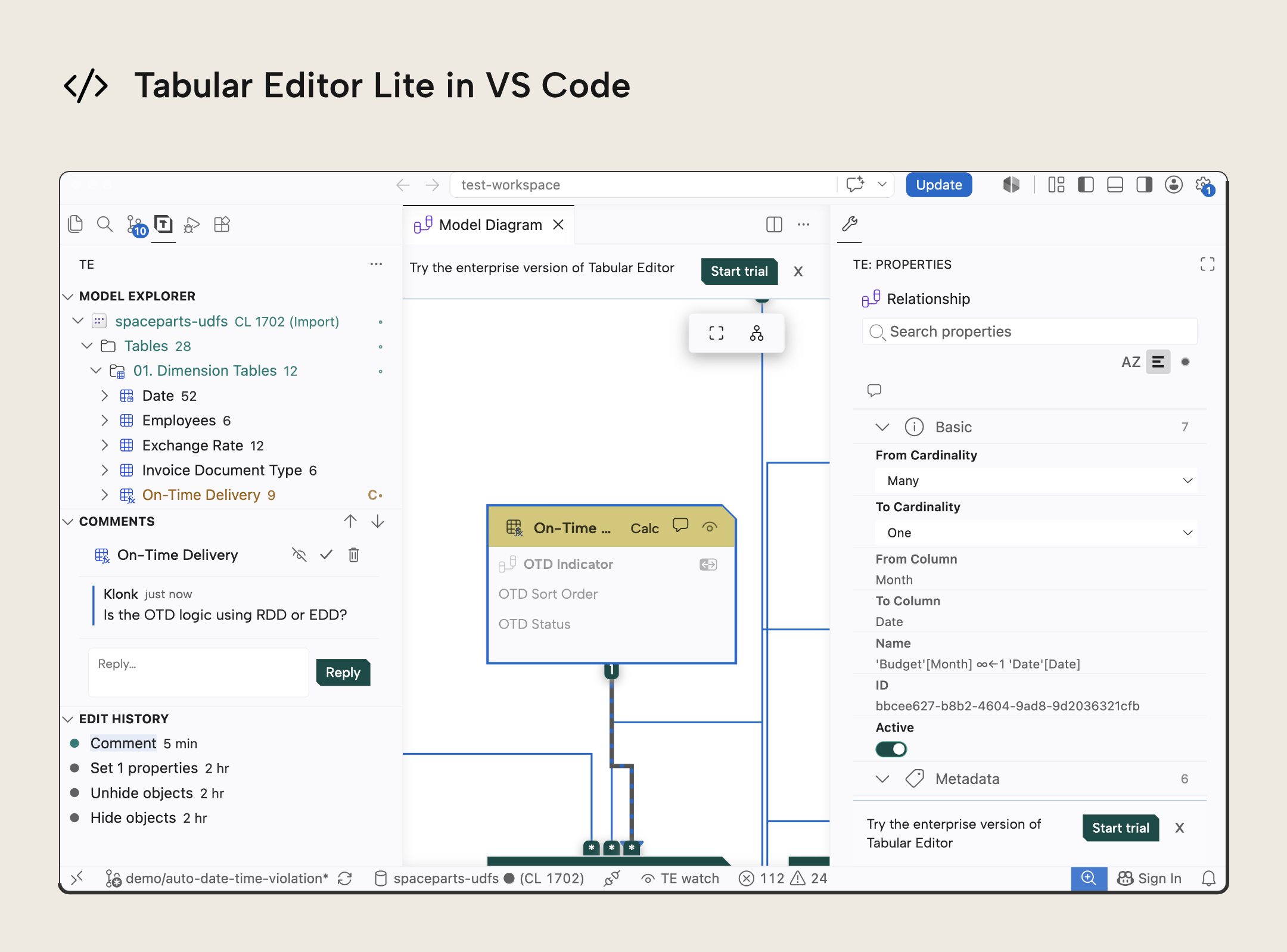
We’re sharing this extension to help those working in VS Code get a better experience developing semantic models, with particular focus on those using AI. You can read more about it in the Tabular Editor Lite launch post. This is just one of our experiments. A few of our other experiments that we’re sharing include:
- An AI skill that helps the latest generation of LLMs effectively translate SQL to DAX (or vice-versa) in cases where it makes sense, and push back when it doesn’t (such as filter context modification or certain aggregations simpler in DAX than SQL).
- A terminal user interface (TUI) that lets you connect to and browse Fabric workspaces, including a custom mono Nerd Font that has all the Fabric icons as glyphs.
- A tool to help you visualize and explore semantic model data.
Not all of our experiments will be directly related to semantic models (or even Fabric), but they will all tackle problems and challenges that we’re facing now or anticipate in the future.
For further reading
- How Tabular Editor supports agentic development for semantic models (Tabular Editor). This article explains our philosophy for agentic development.
- AI agents with command-line tools to manage semantic models (Tabular Editor). Background on why several of these experiments are CLIs rather than MCP servers.
- Agent Skills (Anthropic). Packaging format behind our SQL-to-DAX skill, and how skills load on demand.
In conclusion
With Tabular Editor Forge, we’ll share experiments as free software with the community and our customers. We hope that this software is helpful and interesting, particularly as our sector continues to evolve with the changes brought about by AI and agents. Let us know if you have any feedback or suggestions here or on GitHub.
Develop semantic models with agents, then review every change in Tabular Editor 3.
Give Tabular Editor a spin